
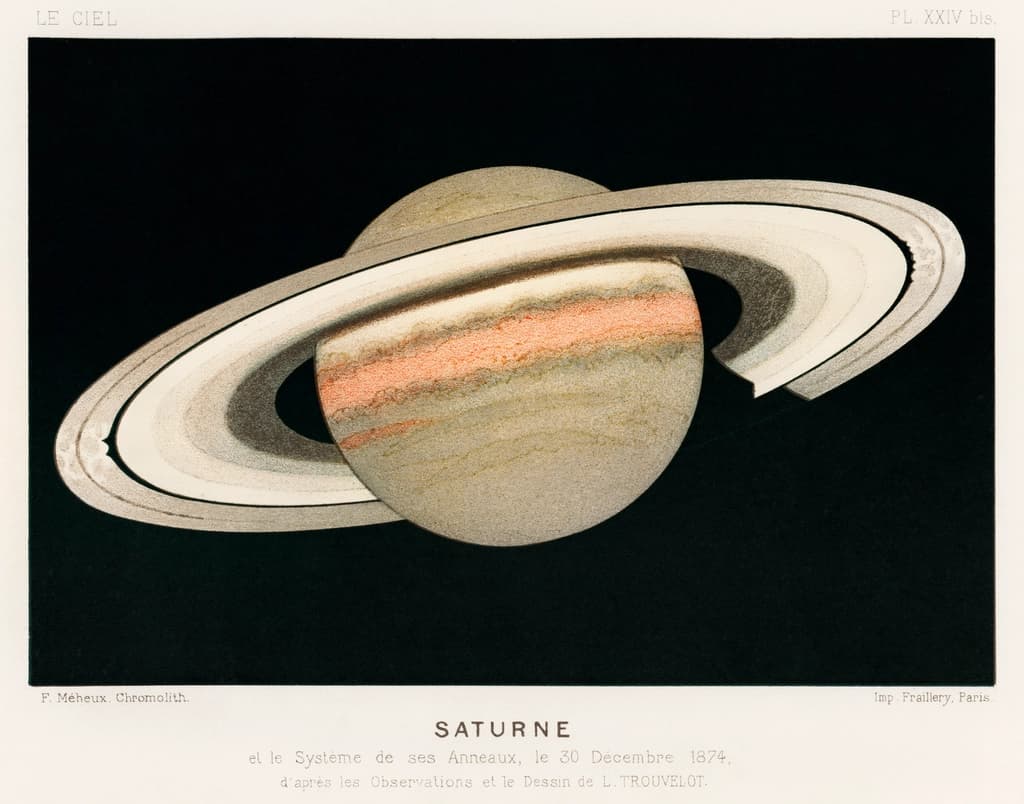
F. Meheux after Trouvelot, Le Ciel, 1874
🪐 What is Saade Sati?
Why the Moon is the Trigger Point
The Moon's role in Vedic astrology and why Saturn transiting near it is so significant.
Saade Sati is defined by Saturn's transit relative to the natal Moon - not the Sun, not the ascendant. To understand why, you need to appreciate the Moon's unique role in Vedic astrology.
THE MOON IN VEDIC ASTROLOGY
- It represents the mind (Manas) - your thoughts, feelings, and emotional reactions
- It governs the mother, nourishment, and early childhood conditioning
- The Moon sign is often considered as important as (or more important than) the Sun sign for personality
- It governs your daily routines, comfort needs, and sense of security
MOON AS THE LENS FOR ALL TRANSITS
In Vedic astrology, important transits (called Gochara) are often measured from the natal Moon, not the ascendant. This is because the Moon represents your subjective experience of reality. Where Saturn is relative to your Moon tells you how your inner world is being pressed and shaped.
- Overthinking and rumination increase
- Old emotional patterns surface for review
- Comfort zones are challenged or removed
- You are forced to emotionally mature and take responsibility
This is not "bad luck" striking randomly. It is a targeted developmental pressure. The mind is being asked to grow up.
MOON STRENGTH MATTERS
A strong Moon - well-placed by sign, house, and dignity - handles Saturn's pressure with more resilience. A weakened Moon (debilitated, afflicted, or waning) makes Saade Sati more challenging. This is why knowing your Moon's condition is key to predicting how intensely you will feel Saade Sati.
The Moon is your mental and emotional body. When Saturn presses on it, your inner world is the arena - not just external events.
Saade Sati Foundations Quiz
Finish all 5 lessons in this module to unlock
Up next
Saade Sati vs. Other Saturn Transits