
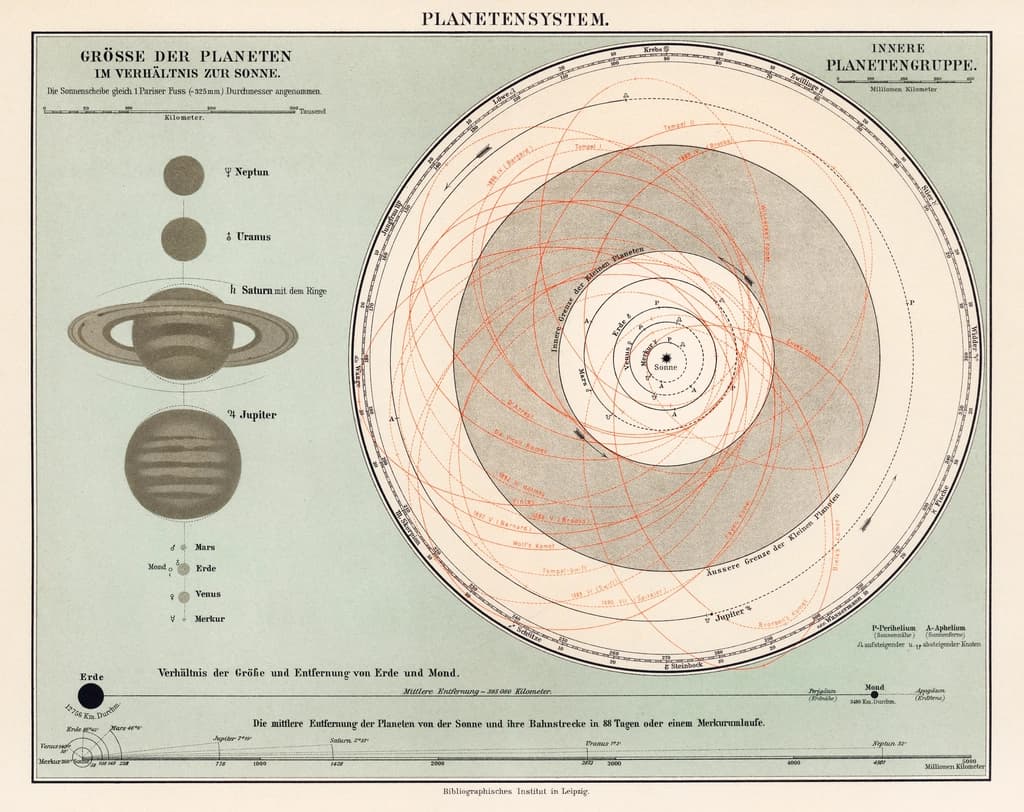
Bibliographisches Institut, Leipzig, 1898
🐉 Rahu and Ketu - The Shadow Planets
Introduction to the Lunar Nodes
Rahu and Ketu as shadow grahas - the mathematical points that drive karmic evolution.
Rahu and Ketu - The Nodal Axis
Rahu (the North Node) and Ketu (the South Node) are not physical planets but mathematical points - the intersections of the Moon's orbital path with the ecliptic. In Vedic astrology they are treated as full-fledged shadow grahas (Chaya Grahas) with enormous influence.
Astronomical Basis
- Rahu (North Node): where the Moon crosses from south to north of the ecliptic
- Ketu (South Node): where the Moon crosses from north to south
Rahu and Ketu are always exactly opposite each other - they are two ends of the same axis. When Rahu is in Taurus, Ketu is in Scorpio.
Motion
The nodes move retrograde through the zodiac continuously, completing one cycle in approximately 18.6 years. They spend roughly 18 months in each sidereal sign.
Mythological Basis
In the Samudra Manthan (churning of the cosmic ocean) myth, the demon Svarbhanu disguised himself as a god and drank the nectar of immortality. The Sun and Moon recognized him and alerted Vishnu, who severed his body with the Sudarshana Chakra. The head became Rahu, the tail became Ketu - both immortal but forever separated. Rahu perpetually tries to swallow the Sun and Moon, causing eclipses.
Key Principle
- Rahu: what the soul craves and must experience in this life (unfulfilled desire)
- Ketu: what the soul has already mastered in past lives (innate skill, detachment)
Rahu and Ketu are shadow planets (Chaya Grahas) always exactly opposite each other, completing a retrograde cycle through the zodiac in 18.6 years.
Module 5 Quiz: Rahu and Ketu
Finish all 5 lessons in this module to unlock
Up next
Rahu - Desire, Illusion, and Worldly Success