
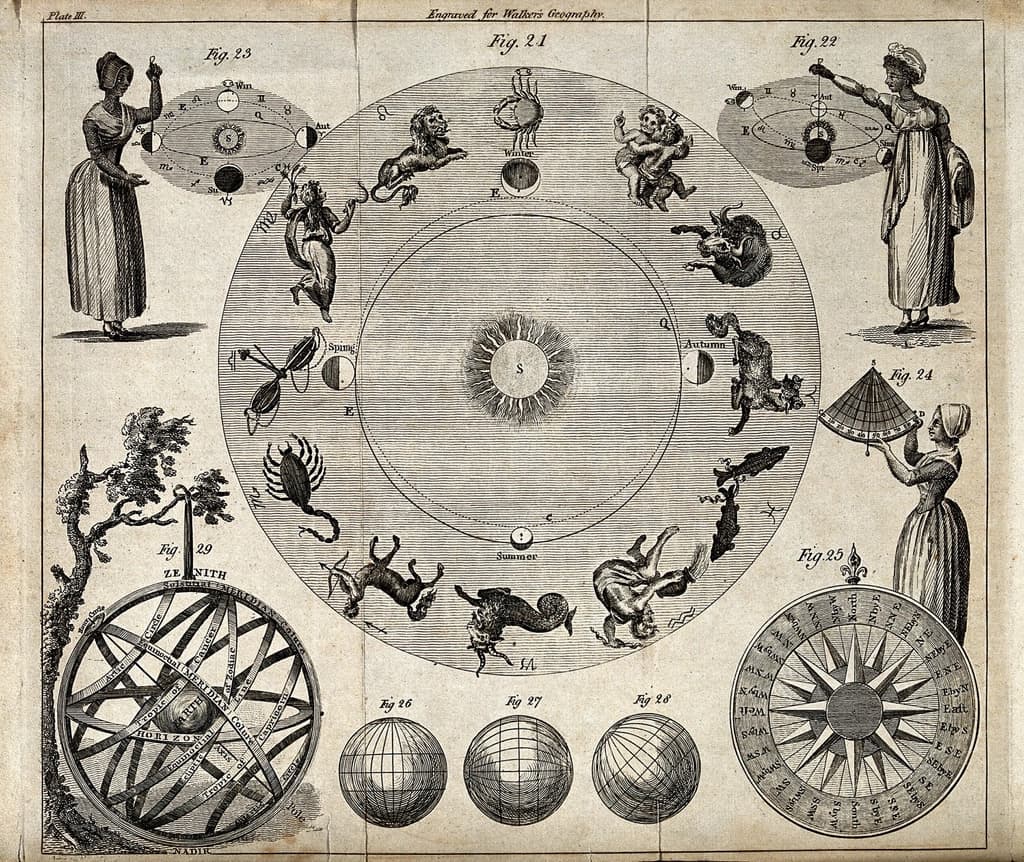
Walker Geography, plate III, c. 1800
🌟 The Foundation
What is a Birth Chart?
Your birth chart is a snapshot of the sky at your time and place of birth.
Your birth chart (Kundali or Janam Kundli) is a map of the sky at the exact moment you were born, from the perspective of your birth place. In Vedic astrology we use the sidereal zodiac, which accounts for the slow shift of the stars over time (ayanamsa).
- 1st House: Self, body, personality
- 2nd House: Wealth, family, speech
- 3rd House: Siblings, courage, communication
- 4th House: Home, mother, inner peace
- 5th House: Children, creativity, intelligence
- 6th House: Health, enemies, service
- 7th House: Marriage, partnerships, business
- 8th House: Transformation, longevity, hidden matters
- 9th House: Fortune, father, higher learning
- 10th House: Career, reputation, public life
- 11th House: Gains, friends, aspirations
- 12th House: Loss, spirituality, foreign lands
Planets are placed in these houses and in the 12 signs (Rashi). The ascendant (Lagna) - the sign rising on the eastern horizon at your birth - sets the first house and colours your whole chart.
Reading a chart involves looking at which planets are where, how they aspect each other, and which planetary periods (dashas) you are in. This gives a framework for understanding strengths, challenges, and timing - not fixed predictions, but a language for self-reflection and planning.
Think of your chart as a cosmic fingerprint: no two are exactly alike. The combination of your rising sign, planetary placements, and current timing creates a unique pattern.
Your chart is a map, not a fixed destiny - use it to understand your natural strengths and timing.
Module 1 Quiz: The Foundation
Finish all 5 lessons in this module to unlock
Up next
The Nine Planets (Navagraha)